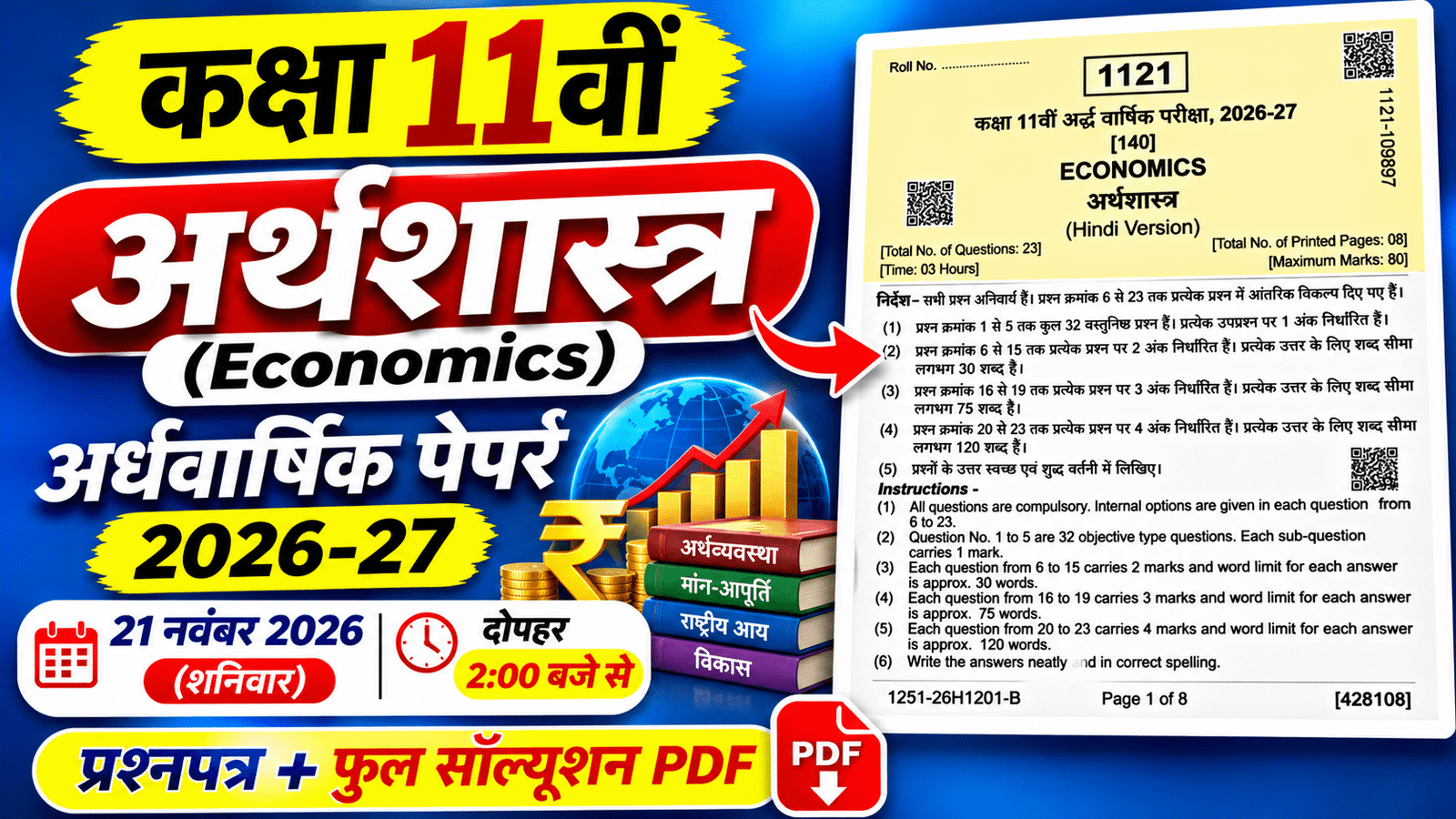
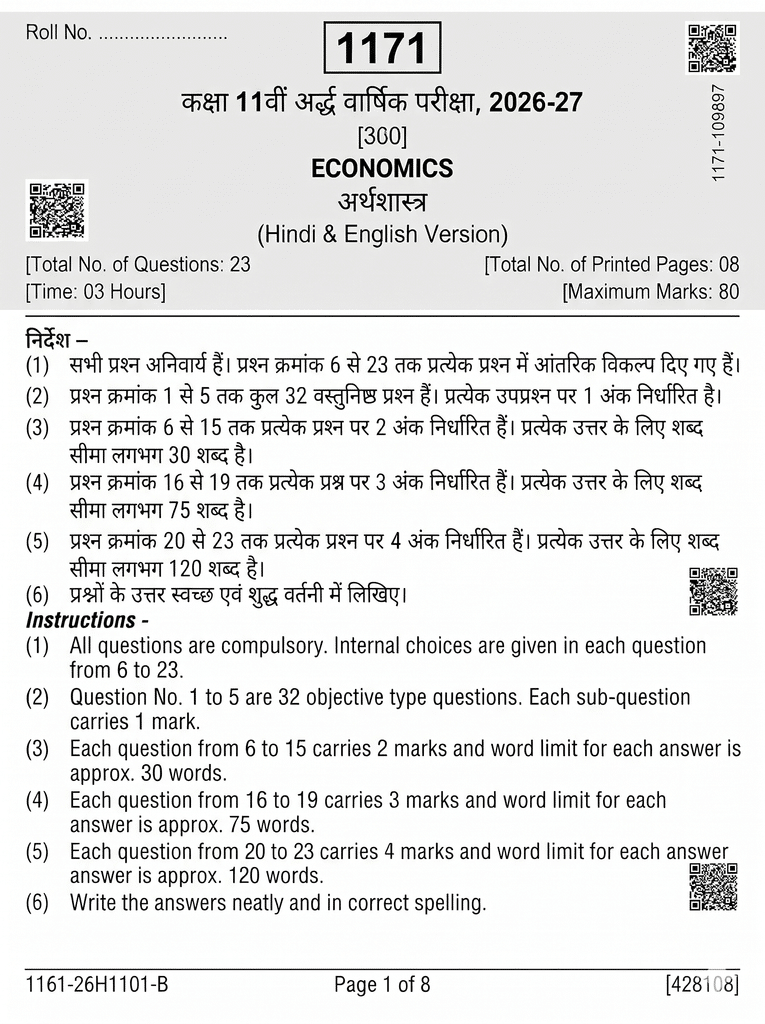
Class 11 Economics Half Yearly Paper 2026-27: मध्य प्रदेश बोर्ड के कक्षा 11वीं के विद्यार्थियों का अर्थशास्त्र (Economics) विषय का अर्धवार्षिक पेपर 21 नवंबर 2026, दिन शनिवार को दोपहर 2 बजे से होने जा रहा है। यदि आप भी कक्षा 11वीं अर्थशास्त्र अर्धवार्षिक पेपर 2026-27 की तैयारी कर रहे हैं, तो यहां आपको महत्वपूर्ण एवं संभावित प्रश्नों के साथ सोशल मीडिया पर वायरल बताए जा रहे पेपर की इमेज देखने को मिलेगी। इसके अलावा Class 11 Economics Half Yearly Paper 2026-27 का अभ्यास प्रश्नपत्र और फुल सॉल्यूशन PDF नीचे दिए गए डाउनलोड लिंक से प्राप्त कर सकते हैं।
(i) ‘अर्थशास्त्र धन का विज्ञान है’ — यह कथन किस अर्थशास्त्री से संबंधित है? / ‘Economics is a science of wealth’ — this statement is related to which economist?
(अ) एडम स्मिथ / Adam Smith (ब) अल्फ्रेड मार्शल / Alfred Marshall (स) लियोनेल रॉबिन्स / Lionel Robbins (द) पॉल सैम्युअलसन / Paul Samuelson
(ii) सांख्यिकी का जनक किसे माना जाता है? / Who is regarded as the father of statistics?
(अ) गॉटफ्राइड एकेनवाल / Gottfried Achenwall (ब) ए. एल. बाउले / A. L. Bowley (स) आर. ए. फिशर / R. A. Fisher (द) क्रॉक्सटन / Croxton
(iii) निम्नलिखित में से कौन-सा अपकिरण का माप है? / Which of the following is a measure of dispersion?
(अ) समांतर माध्य / Arithmetic Mean (ब) माध्यिका / Median (स) बहुलक / Mode (द) मानक विचलन / Standard Deviation
(iv) सहसंबंध गुणांक (r) का मान सदैव किसके बीच होता है? / Correlation coefficient (r) always lies between:
(अ) 0 से +1 (ब) -1 से +1 (स) -1 से 0 (द) -∞ से +∞
(v) भारत में नीति आयोग (NITI Aayog) का गठन किस वर्ष किया गया? / In which year was NITI Aayog constituted in India?
(अ) 1950 (ब) 1991 (स) 2015 (द) 2016
(vi) भारत में नई आर्थिक नीति (उदारीकरण, निजीकरण, वैश्वीकरण) किस वर्ष लागू की गई? / In which year was New Economic Policy introduced in India?
(अ) 1980 (ब) 1985 (स) 1991 (द) 2000
(i) जो समंक अन्वेषक स्वयं मूल रूप से एकत्रित करता है, उन्हें ……………………. समंक कहते हैं। / Data originally collected by an investigator are called ……………………. data.
(ii) वर्ग अंतराल 30–40 का मध्य बिंदु ……………………. होगा। / Mid-point of class interval 30–40 will be ……………………. .
(iii) श्रेणी में सर्वाधिक बार आने वाला पद मूल्य ……………………. कहलाता है। / The value occurring most frequently in a series is called ……………………. .
(iv) उपभोक्ता मूल्य सूचकांक (CPI) का उपयोग ……………………. मापने में किया जाता है। / Consumer Price Index (CPI) is used to measure ……………………. .
(v) भारत में पहली पंचवर्षीय योजना ……………………. में प्रारंभ की गई थी। / First Five-Year Plan in India started in ……………………. .
(vi) ग्रामीण साख की सर्वोच्च संस्था ……………………. है। / Apex institution for rural credit in India is ……………………. .
| (A) Column ‘A’ | (B) Column ‘B’ |
|---|---|
| (1) अर्थशास्त्र की कल्याण संबंधी परिभाषा | (क) अल्फ्रेड मार्शल |
| (2) समांतर माध्य का सूत्र (प्रत्यक्ष विधि) | (ख) X̄ = ΣX / N |
| (3) पूर्ण धनात्मक सहसंबंध | (ग) r = +1 |
| (4) फिशर का सूचकांक | (घ) आदर्श सूचकांक |
| (5) हरित क्रांति के जनक (भारत में) | (ङ) डॉ. एम. एस. स्वामीनाथन |
| (6) विश्व व्यापार संगठन (WTO) की स्थापना | (च) 1995 |
(i) सांख्यिकी केवल संख्यात्मक तथ्यों का अध्ययन करती है। / Statistics studies only numerical facts.
(ii) माध्यिका ज्ञात करने के लिए आँकड़ों को आरोही या अवरोही क्रम में व्यवस्थित करना आवश्यक है। / Arranging data in ascending or descending order is essential to find median.
(iii) पूर्ण ऋणात्मक सहसंबंध गुणांक का मान शून्य होता है। / Value of perfect negative correlation coefficient is zero.
(iv) स्वतंत्रता प्राप्ति के समय भारतीय अर्थव्यवस्था एक विकसित अर्थव्यवस्था थी। / At independence, Indian economy was a developed economy.
(v) हरित क्रांति का प्रारंभिक लाभ मुख्यतः गेहूँ और चावल की फसल को मिला। / Initial benefits of Green Revolution went mainly to wheat and rice.
(vi) मानव पूंजी निर्माण से श्रम उत्पादकता में वृद्धि होती है। / Human capital formation increases labour productivity.
(i) अर्थशास्त्र की दुर्लभता संबंधी परिभाषा किसने दी? / Who gave the scarcity definition of economics?
(ii) भारत में जनगणना कितने वर्षों के अंतराल में की जाती है? / At what interval is census conducted in India?
(iii) अपवर्जी वर्ग अंतराल में उच्च सीमा किस वर्ग में सम्मिलित होती है? / In exclusive class interval, in which class is upper limit included?
(iv) सूचकांक (Index Number) की कोई एक विशेषता लिखिए। / Write any one characteristic of an index number.
(v) औपनिवेशिक शासन काल में भारत की राष्ट्रीय आय के अनुमान लगाने वाले प्रमुख अर्थशास्त्री का नाम लिखिए। / Name a prominent economist who estimated India’s national income during colonial rule.
(vi) उदारीकरण (Liberalization) का क्या आशय है? / What is meant by liberalization?
(vii) मौसमी बेरोजगारी मुख्यतः किस क्षेत्र में पाई जाती है? / Seasonal unemployment is mainly found in which sector?
(viii) जैविक कृषि (Organic Farming) का एक प्रमुख लाभ लिखिए। / Write one major benefit of organic farming.
अथवा / OR
आर्थिक क्रिया एवं अनार्थिक क्रिया में कोई दो अंतर लिखिए। / Write any two differences between economic and non-economic activities.
अथवा / OR
सांख्यिकी की कोई दो सीमाएँ लिखिए। / Write any two limitations of statistics.
अथवा / OR
एक अच्छी प्रश्नावली के कोई दो गुण लिखिए। / Write any two qualities of a good questionnaire.
अथवा / OR
अपवर्जी एवं समावेशी वर्ग अंतराल में कोई दो अंतर लिखिए। / Write any two differences between exclusive and inclusive class intervals.
अथवा / OR
निम्नलिखित आँकड़ों से माध्यिका (Median) ज्ञात कीजिए: 15, 25, 10, 35, 20, 40, 30। / Find median from data: 15, 25, 10, 35, 20, 40, 30.
अथवा / OR
सूचकांक (Index Number) की कोई दो उपयोगिताएँ लिखिए। / Write any two uses of index numbers.
अथवा / OR
औपनिवेशिक काल में भारत के विदेशी व्यापार की कोई दो विशेषताएँ लिखिए। / Write any two features of India’s foreign trade during colonial rule.
अथवा / OR
हरित क्रांति से क्या अभिप्राय है? इसके कोई दो सकारात्मक प्रभाव लिखिए। / What is meant by Green Revolution? Write any two positive impacts of it.
अथवा / OR
वैश्वीकरण (Globalization) को बढ़ावा देने वाले कोई दो कारक लिखिए। / Write any two factors promoting globalization.
अथवा / OR
निर्धनता निवारण के लिए सरकार द्वारा अपनाए गए कोई दो उपाय लिखिए। / Write any two measures adopted by government for poverty alleviation.
अथवा / OR
आँकड़ों के चित्रमय प्रदर्शन के कोई तीन प्रमुख लाभ लिखिए। / Write any three main merits of diagrammatic presentation of data.
अथवा / OR
प्रत्यक्ष व्यक्तिगत अनुसंधान विधि के कोई तीन गुण या दोष लिखिए। / Write any three merits or demerits of direct personal investigation method.
अथवा / OR
औद्योगिक नीति प्रस्ताव, 1956 (IPR 1956) की कोई तीन प्रमुख विशेषताएँ लिखिए। / Write any three main features of Industrial Policy Resolution, 1956.
अथवा / OR
भारत में ऊर्जा संकट या आधारभूत संरचना के विकास के कोई तीन महत्व लिखिए। / Write any three importance of infrastructure development in India.
वर्ग अंतराल (Class Interval): 0–10, 10–20, 20–30, 30–40, 40–50
बारंबारता (Frequency, f): 4, 6, 10, 5, 5
अथवा / OR
निम्नलिखित आँकड़ों से बहुलक (Mode) ज्ञात कीजिए: / Calculate mode from following data:
प्राप्तांक (Marks): 10–20, 20–30, 30–40, 40–50, 50–60
छात्रों की संख्या (f): 5, 12, 18, 9, 6
X: 10, 20, 30, 40, 50
Y: 15, 25, 35, 45, 55
अथवा / OR
भारित सूचकांक (Weighted Index Number) एवं साधारण सूचकांक में अंतर स्पष्ट कीजिए तथा आधार वर्ष चयन की कोई तीन सावधानियाँ लिखिए। / Distinguish between weighted and simple index numbers and state three precautions in selecting base year.
अथवा / OR
भारतीय अर्थव्यवस्था में कृषि क्षेत्र की समस्याओं का वर्णन कीजिए तथा कृषि उत्पादकता बढ़ाने के सुझाव दीजिए। / Describe problems of agricultural sector in Indian economy and suggest ways to increase agricultural productivity.
अथवा / OR
सतत विकास (Sustainable Development) की अवधारणा को स्पष्ट कीजिए तथा पर्यावरण संरक्षण के कोई चार उपाय लिखिए। / Explain concept of sustainable development and write any four measures for environmental conservation.
कक्षा 11वीं अर्थशास्त्र (Economics) अर्द्धवार्षिक परीक्षा 2026-27 के सभी 23 प्रश्नों का सम्पूर्ण हल नीचे दिए गए बटन से डाउनलोड करें।