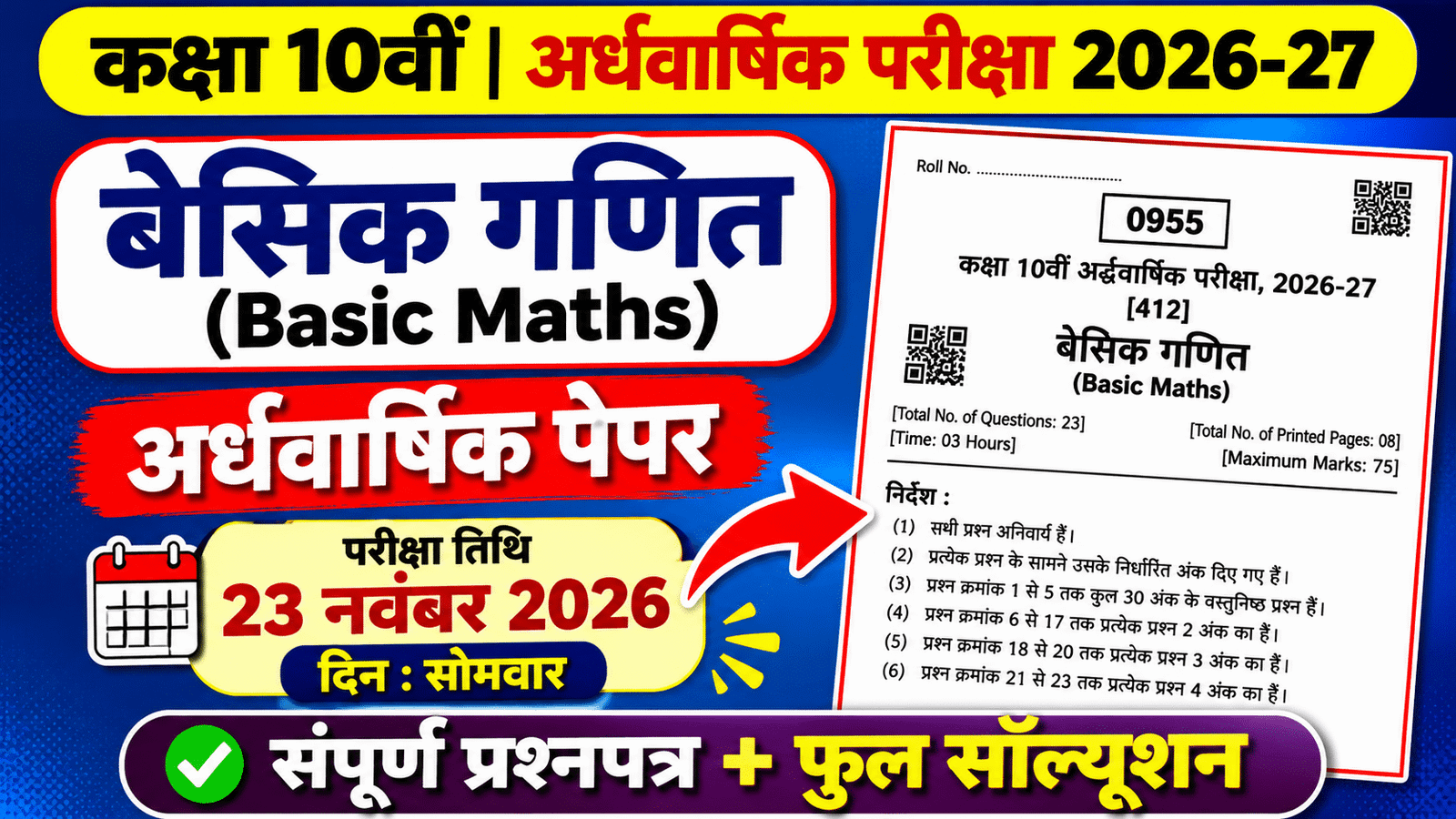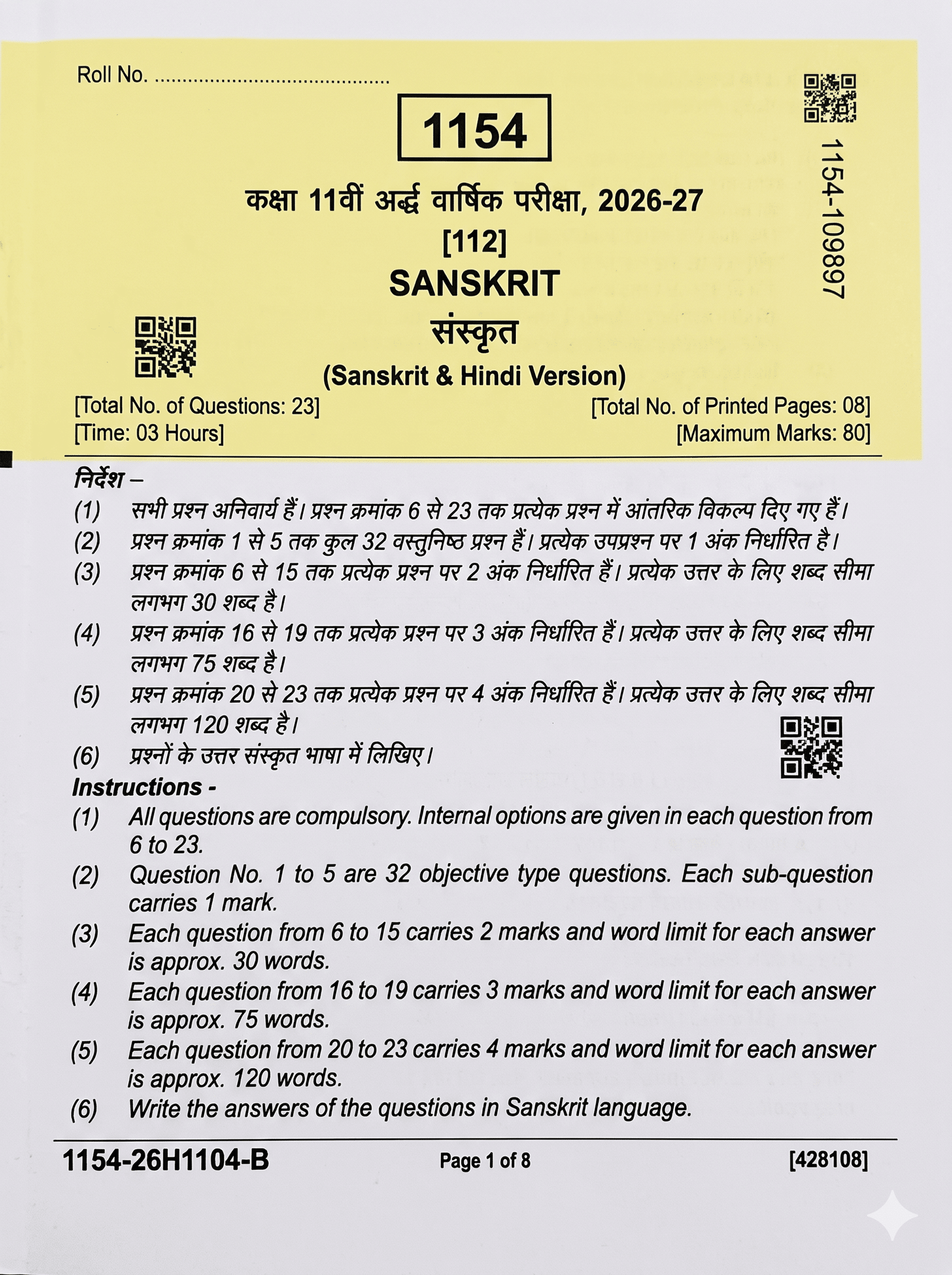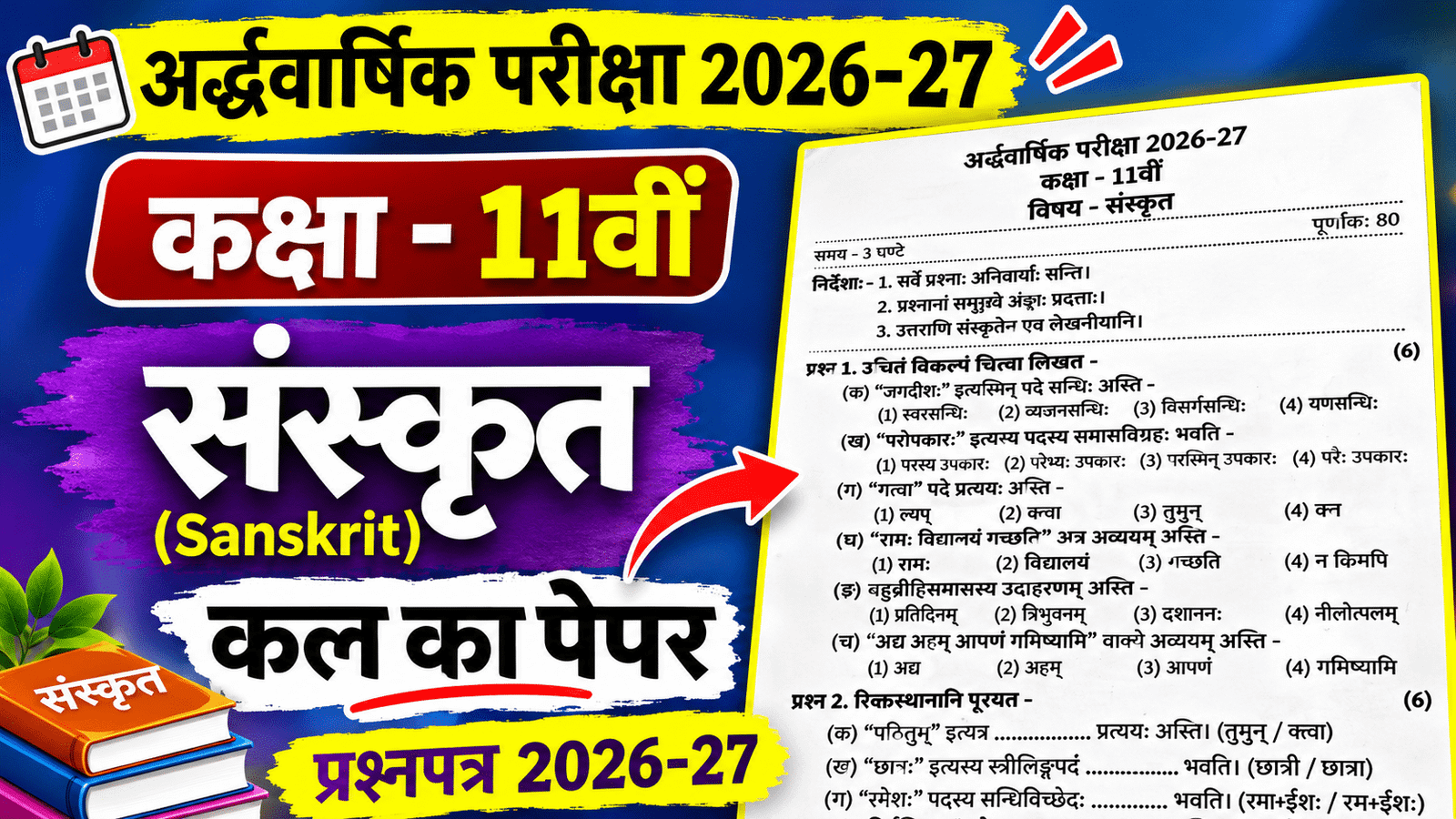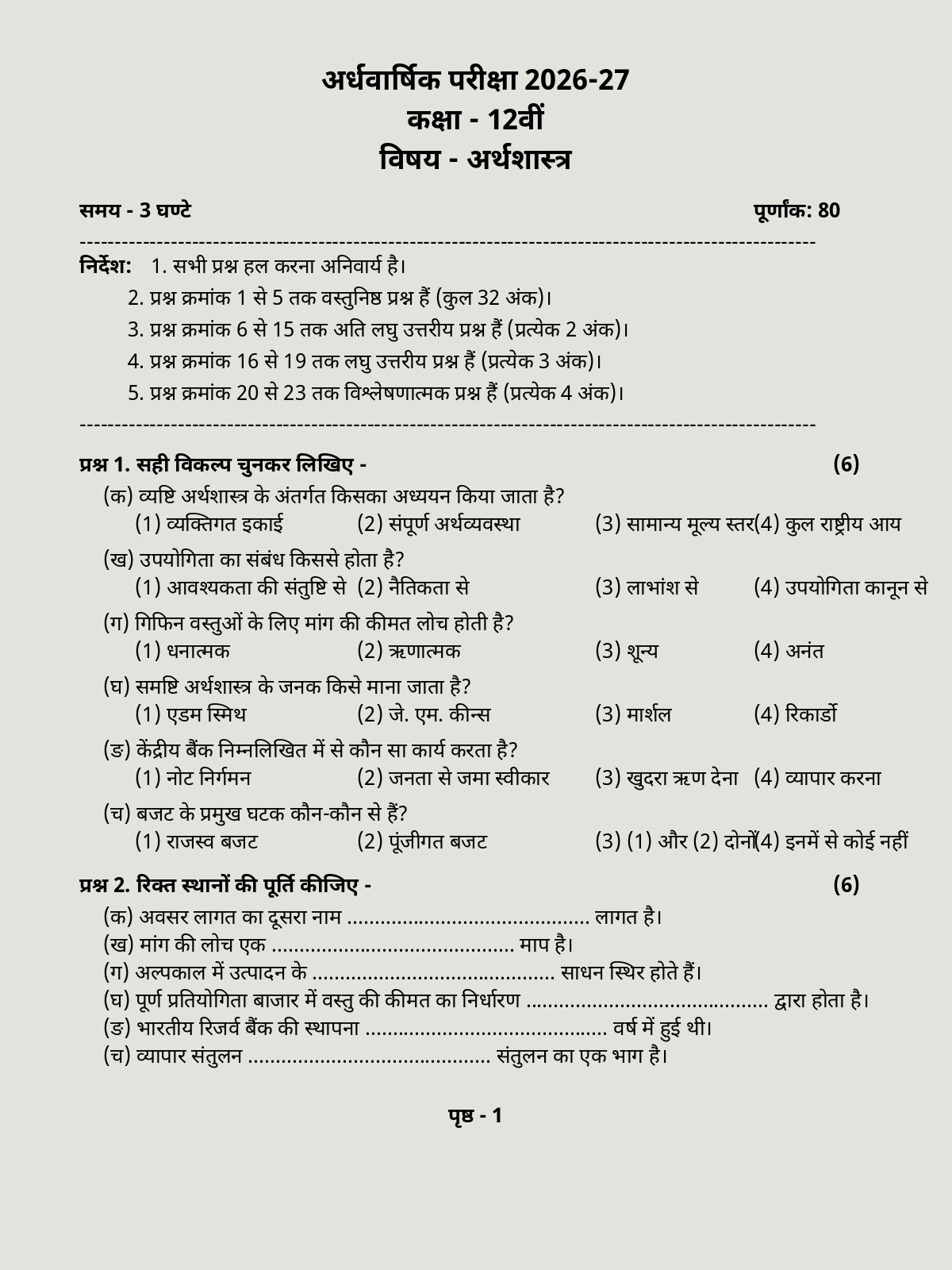
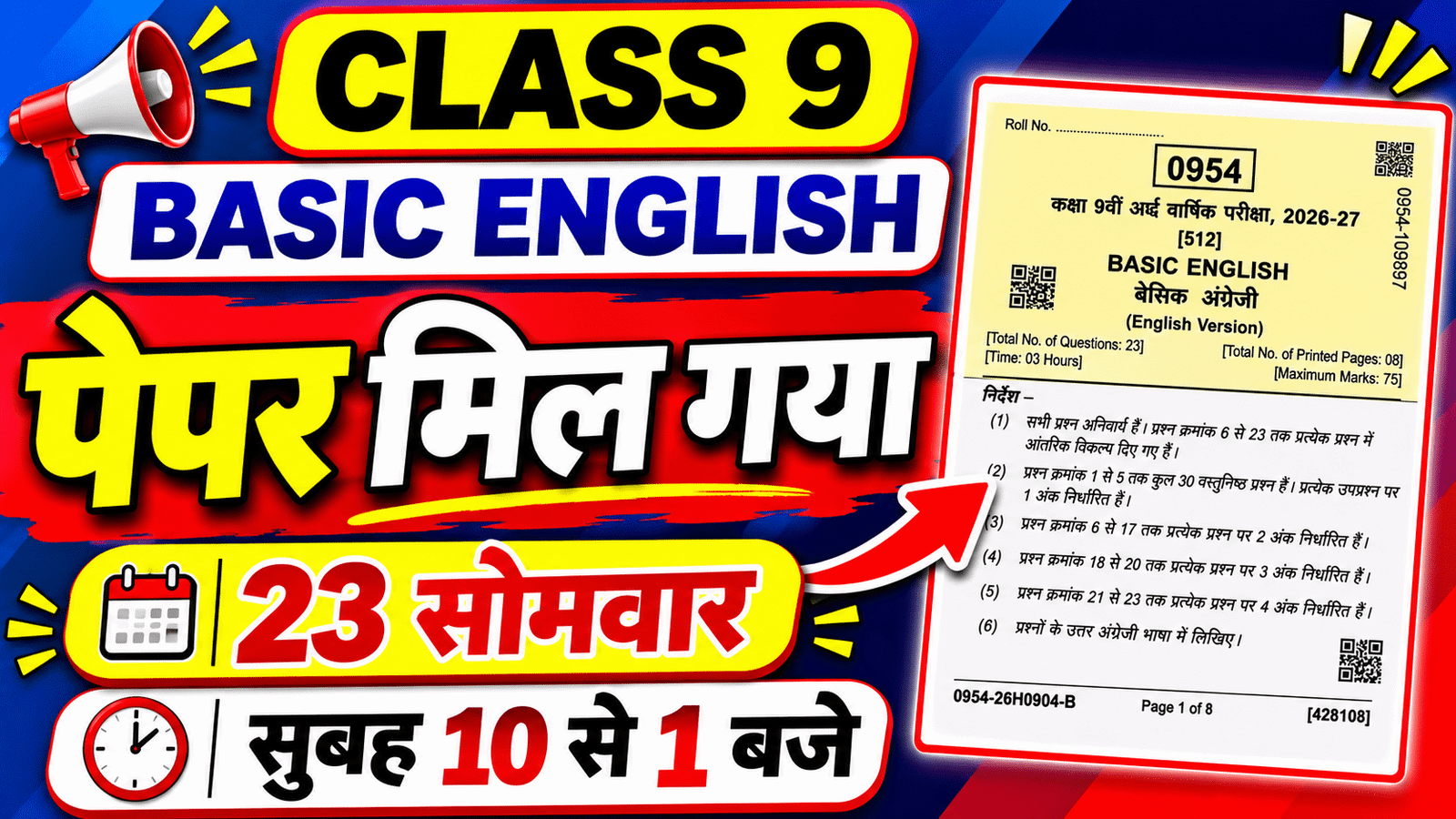
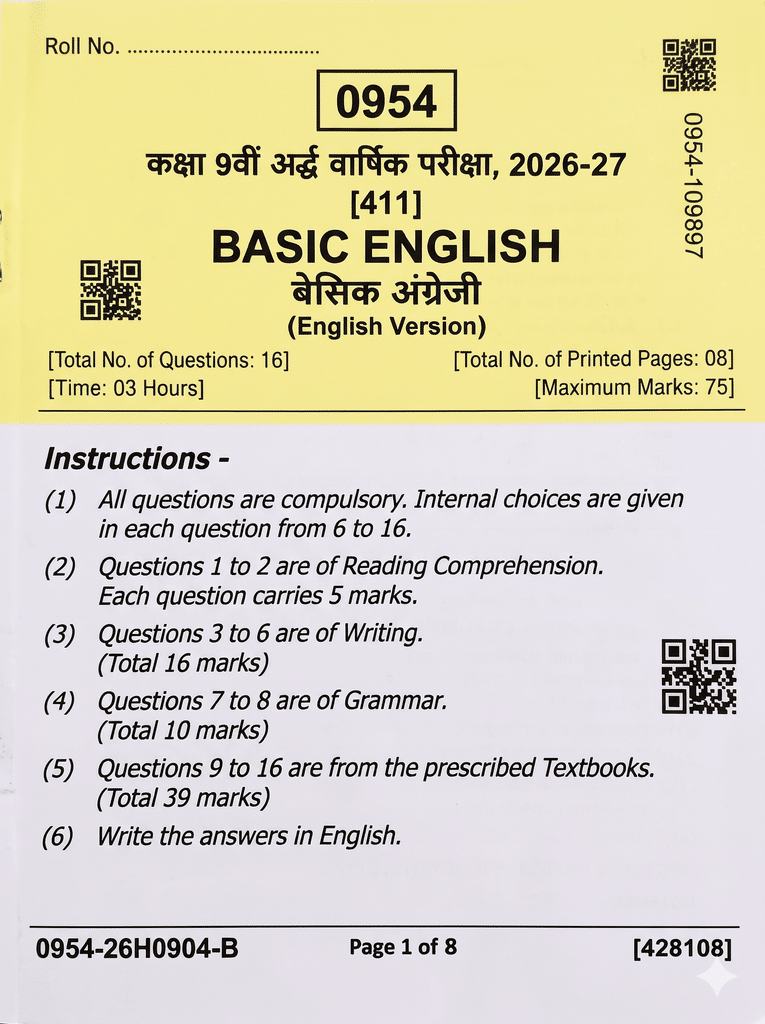
Class 9 Basic English Half Yearly Paper 2026-27: मध्य प्रदेश बोर्ड के कक्षा 9वीं के विद्यार्थियों के लिए अंग्रेजी विषय की अर्धवार्षिक परीक्षा 23 नवंबर 2026, दिन सोमवार को सुबह 10:00 बजे से दोपहर 1:00 बजे तक आयोजित होने वाली है। ऐसे में यदि आप भी कक्षा 9वीं अंग्रेजी अर्धवार्षिक पेपर 2026-27 की तैयारी कर रहे हैं और परीक्षा में आने वाले महत्वपूर्ण प्रश्नों को देखना चाहते हैं, तो यह पोस्ट आपके लिए उपयोगी होने वाली है। यहां आपको Class 9 English Half Yearly Paper 2026-27 के परीक्षा पैटर्न के अनुसार महत्वपूर्ण एवं संभावित प्रश्नों की जानकारी मिलेगी। इसके अलावा कक्षा 9वीं अंग्रेजी अर्धवार्षिक पेपर 2026-27 का संपूर्ण अभ्यास प्रश्नपत्र और उसका सॉल्यूशन भी नीचे दिया जाएगा, जिसकी सहायता से आप अपनी परीक्षा की बेहतर तैयारी कर सकते हैं।
In student life, discipline plays a vital role in building character and sharpening the mind. A disciplined student wakes up on time, attends classes regularly, respects teachers and elders, and balances study with sports and rest. Discipline does not take away freedom; rather, it teaches us how to use our freedom responsibly. Great leaders, scientists and sportspersons reach the heights of glory only through self-discipline and consistent effort.
- (a) What is the foundation of a successful and meaningful life?
(i) Wealth(ii) Discipline(iii) Luck(iv) Anger
- (b) In student life, discipline helps in:
(i) Wasting time(ii) Avoiding duties(iii) Building character(iv) Creating confusion
- (c) Discipline teaches us how to use our ______ responsibly.
(i) Money(ii) Freedom(iii) Power(iv) Vehicles
- (d) Find a word from the passage which means ‘regularity in being on time’.
- (e) Find the antonym (opposite) of ‘success’ from the passage.
Today, rapid population growth, deforestation, industrial waste and careless usage have created a severe water crisis in many parts of the world. If we do not conserve water today, future generations will face acute scarcity. Rainwater harvesting, fixing leaking taps, reusing household water for gardening and preventing river pollution are simple yet effective steps. Saving every drop of water is our moral duty toward nature and humanity.
- (a) How much of the Earth’s surface is covered with water?
(i) Nearly 50%(ii) Nearly 71%(iii) Nearly 25%(iv) Nearly 90%
- (b) Which of the following is a primary source of freshwater?
(i) Oceans(ii) Rivers(iii) Deserts(iv) Glaciers only
- (c) What has created a severe water crisis today?
(i) Rainwater harvesting(ii) Tree plantation(iii) Industrial waste and careless usage(iv) Saving water
- (d) Write any two effective steps mentioned in the passage to conserve water.
- (e) Find a word from the passage which means ‘shortage’.
Students who read good biographies, science articles and classic literature develop empathy and broader perspectives on life. Even twenty minutes of daily reading before sleep reduces stress and sharpens memory. In the digital age, while screens often distract young minds, printed books and thoughtful reading habits remain the surest path to lifelong learning and intellectual growth.
- (a) Give a suitable title to the passage. [1]
- (b) Prepare notes on the passage using suitable headings and sub-headings. [3]
You are Aryan Sharma, studying in Class 9th at Government Higher Secondary School, Hatta (Dist. Damoh). Write an application to your Principal requesting him/her to issue your Transfer Certificate (T.C.) as your father has been transferred to Bhopal.
You are Kavita Verma, residing at 14, Civil Lines, Damoh. Write a letter to your friend congratulating him/her on his/her brilliant success in the examination.
Write an essay on any one of the following topics in about 180–200 words:
- (i) Wonders of Science in Daily Life
- (ii) Importance of Trees and Environment Protection
- (iii) Value of Games and Sports
- (iv) An Ideal Student
Write a short paragraph on “Importance of Cleanliness (Swachh Bharat)” in about 80 words.
The picture shows a lush green public park in the early morning. Several elderly people are walking along the paved track, while a group of children and adults are practising yoga on mats. Birds are chirping on tall trees, and fresh sunlight is filtering through the leaves. Everyone looks energetic, healthy and cheerful.
Write a meaningful paragraph describing this scene in about 80 words.
- (i) The sun ______ in the east. (rise / rises / rose)
- (ii) My brother is ______ university student. (a / an / the)
- (iii) It has been raining ______ morning. (since / for / from)
- (iv) We ______ follow traffic rules strictly. (must / might / could)
- (v) Distribute these sweets ______ the children. (between / among / into)
- (vi) He did not buy ______ apples from the market. (some / any / much)
- (vii) Work hard ______ you will fail. (and / or / but)
- (i) She sings a sweet song. (Change into Negative Sentence)
- (ii) The boys are flying kites. (Change into Passive Voice)
- (iii) Mohan completed his homework yesterday. (Change into Interrogative Sentence)
- (iv) He is very weak. He cannot walk fast. (Combine the sentences using ‘so…that’)
- (v) They watch a movie every Sunday. (Change into Simple Past Tense)
- (vi) Riya said to me, “I am reading a novel.” (Change into Indirect Speech)
- (vii) Unless you run fast, you will miss the bus. (Rewrite using ‘If’)
- (i) How old was Margie in the lesson The Fun They Had?
(a) Ten years(b) Eleven years(c) Twelve years(d) Thirteen years
- (ii) Who helped Evelyn Glennie to continue with music?
(a) Ustad Bismillah Khan(b) Ron Forbes(c) Albert Einstein(d) A. P. J. Abdul Kalam
- (iii) Where was Abdul Kalam’s house situated in My Childhood?
(a) On Mosque Street in Rameswaram(b) Near Marina Beach in Chennai(c) In Delhi(d) In Madurai
- (iv) What gift did Kezia make for her father’s birthday?
(a) A flower bouquet(b) A pin-cushion(c) A greeting card(d) A wooden box
- (a) Where did young Abdul Kalam grow up?
(i) In Chennai(ii) In Rameswaram(iii) In Bengaluru(iv) In Delhi
- (b) How did Kalam earn his first wages?
(i) By teaching students(ii) By selling fruits(iii) By helping distribute newspapers(iv) By working in a shop
- (c) Find a word from the passage which means ‘natural or inborn’.
Washing dust from leaf and lane,
Cool and sweet the breezes blow,
Making weary spirits glow.
- (a) What does the evening rain wash away?
(i) Colour from flowers(ii) Dust from leaf and lane(iii) Birds from trees(iv) Clouds from the sky
- (b) How do the breezes feel in the stanza?
(i) Hot and dry(ii) Harsh and noisy(iii) Cool and sweet(iv) Cold and bitter
- (c) Find a word from the stanza which means ‘tired’.
- (i) What things about the printed book did Margie and Tommy find strange in The Fun They Had?
- (ii) Why did Aurangzeb ban the playing of the pungi in the royal residence?
- (iii) Why was Kezia afraid of her father in The Little Girl?
- (iv) Why did Albert Einstein’s playmates call him “Brother Boring”?
- (v) What two “important” and “earth-shaking” decisions did the doctor take while looking into the mirror?
- (vi) How did Abdul Kalam’s science teacher Sivasubramania Iyer try to break social barriers?
- (vii) Why did Santosh Yadav’s parents agree to pay for her schooling in Delhi?
- (viii) What was the secret of Maria Sharapova’s rapid rise to the top in women’s tennis?
- (i) Which road did the poet choose in The Road Not Taken and why?
- (ii) How does the wind deal with weak fires and strong fires in the poem Wind?
- (iii) What sounds and sights of nature does the poet miss in The Lake Isle of Innisfree?
- (i) Why did the child refuse the man’s offers of sweets, toys and balloons after getting lost in The Lost Child?
- (ii) Why did Grandfather decide to return Toto to the tonga-driver in The Adventures of Toto?
- (iii) How did Iswaran describe the uprooted tree on the highway in Iswaran the Storyteller?
How did Evelyn Glennie become a source of inspiration for handicapped people around the world?
Describe the incident when Albert Einstein wrote a historic letter to President Franklin D. Roosevelt. What was its impact?
What central message does Subramania Bharati convey through the poem Wind?
Narrate the story of Saint Peter and the greedy woman in A Legend of the Northland. What moral lesson does it teach?
How did the wise guru outsmart the foolish king and save his disciple in In the Kingdom of Fools?
Why did the Swallow decide to stay with the Happy Prince instead of flying to Egypt? What sacrifices did both of them make?
कक्षा 9वीं बेसिक इंग्लिश अर्द्धवार्षिक परीक्षा 2026-27 के सभी 16 प्रश्नों का सम्पूर्ण हल नीचे दिए गए बटन से पीडीएफ (PDF) फॉर्मेट में डाउनलोड करें।