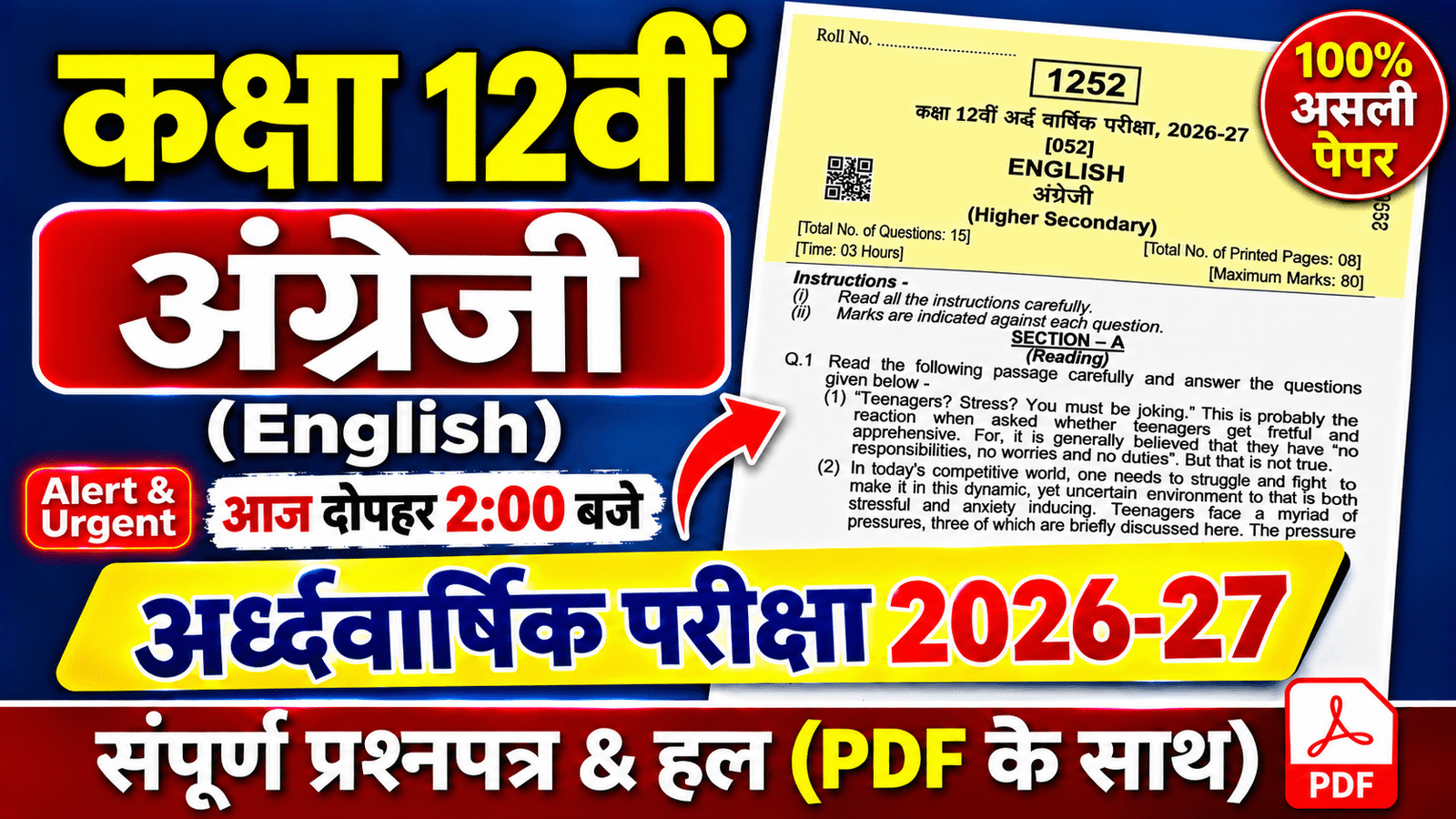
Class 12th English Half Yearly Paper 2026-27: नमस्कार विद्यार्थियों! कक्षा 12वीं अंग्रेजी अर्धवार्षिक परीक्षा 2026 की तैयारी करने वाले विद्यार्थियों के लिए यह पोस्ट महत्वपूर्ण है। यहाँ आपको 23 नवंबर 2026 के Class 12th English Ardhvarshik Paper 2026 से संबंधित महत्वपूर्ण प्रश्न, मॉडल पेपर और संपूर्ण समाधान नीचे देखने को मिलेंगे।
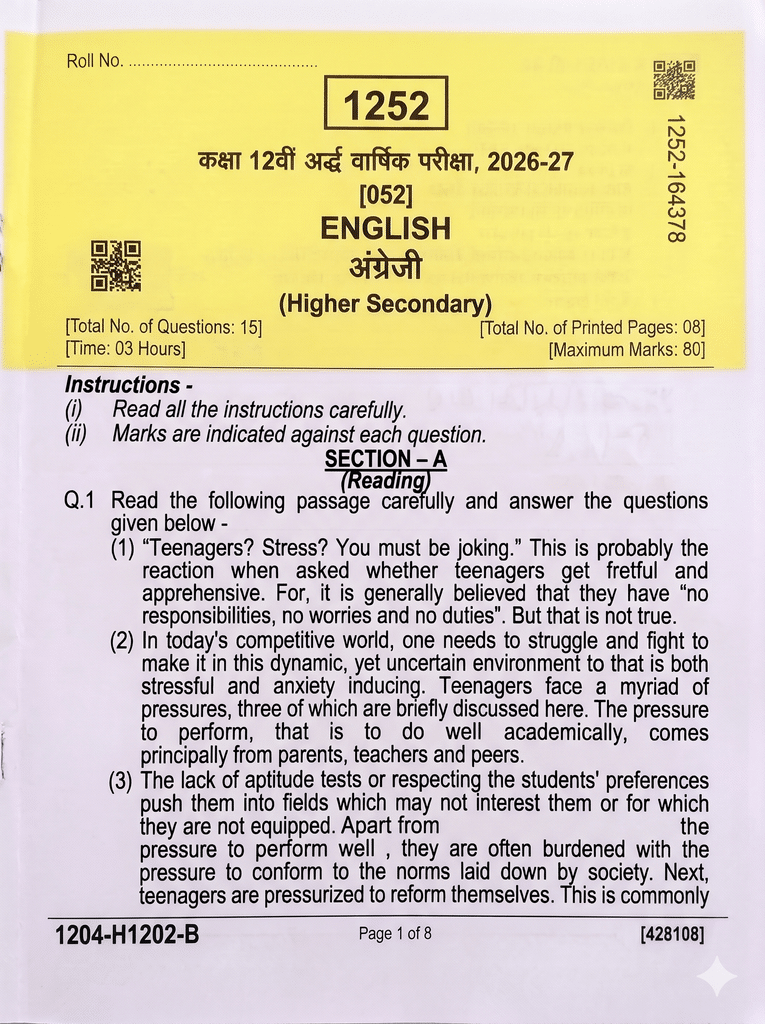
कक्षा 12वीं अर्द्ध वार्षिक परीक्षा, 2026-27
ENGLISH
Instructions –
- Read all the questions carefully.
- Read the instructions given with the questions before attempting them.
- Marks of each question are indicated against it.
- This question paper is divided into four sections: Section A (Reading), Section B (Writing), Section C (Grammar), and Section D (Textbooks).
- All questions are compulsory. Internal choices are given wherever necessary.
- Write the answers neatly and in correct spelling.
(1) “Teenagers? Stress? You must be joking.” This is probably the reaction when asked whether teenagers get fretful and apprehensive. For, it is generally believed that they have “no responsibilities, no worries and no duties”. But that is not true.
(2) In today’s competitive world, one needs to struggle and fight to make it in this dynamic, yet uncertain environment that is both stressful and anxiety inducing. Teenagers face a myriad of pressures, three of which are briefly discussed here. The pressure to perform, that is to do well academically, comes principally from parents, teachers and peers.
(3) The lack of aptitude tests or respecting the students’ preferences push them into fields which may not interest them or for which they are not equipped. Apart from the pressure to perform well, they are often burdened with the pressure to conform to the norms laid down by society. Next, teenagers are pressurized to reform themselves. This is commonly experienced in matters of appearance, substance and attitude.
(4) Stress among teenagers is on the rise because of unrealistic expectations of parents, peer pressure, and academic competition. However, stress is not always harmful; a small amount of pressure can motivate students to stay focused and work hard if managed properly.
(5) Managing stress requires open communication with parents and teachers, regular physical exercise, adequate sleep, and healthy hobbies. Counseling and time management also help adolescents cope effectively while schools and families focus on guidance and emotional support.
- The following passage is about –
- Academic pressure on teenagers mainly comes from –
- Lack of aptitude tests pushes students into fields that –
- Teenagers are often pressurized to conform to –
- The word in the passage which means “eager or thrilled” is –
- Which of the following helps teenagers manage stress?
- A dynamic and uncertain environment often causes –
- Which of these is NOT mentioned as a pressure on teenagers?
- Counseling and time management help adolescents to –
- Give a suitable title to the passage.
Effective time management is an essential skill for students, especially during examinations. A well-planned timetable helps learners divide their syllabus into smaller, manageable parts and avoids last-minute panic. Prioritizing difficult topics while setting aside time for revision improves retention and accuracy. Short breaks between study sessions refresh the mind and prevent fatigue. Students should also limit distractions such as excessive screen time and social media during study hours. Consistent daily effort is far more effective than studying for long hours irregularly.
- Importance of English
- Benefits of Yoga and Exercise
- Work From Home: Advantages and Challenges
- Value of Games and Sports
- It is the hottest day of the season, ……………… ?
- He did not make ……………… mistake in the test.
- She asked if she ……………… see the doctor.
- He is senior ……………… me by two years.
- Each of the boys ……………… given a prize.
- He is too weak to walk. (Rewrite using ‘so…that’)
- They are playing football. (Change into passive voice)
- If you do not work hard, you will fail. (Rewrite using ‘Unless’)
- The boy is my brother. He is wearing a blue shirt. (Combine into a relative clause using ‘who’)
- She said to me, “I am reading a book.” (Change into indirect speech)
- We / live / here / 2018 / since. (Rearrange the words to make a meaningful sentence)
No even the kindest solicitude of his friends, nor their haughty promises of more lucrative situations, could avail to turn him. He had persisted with his rattraps and peddled them from door to door, while the old crofter welcomed him warmly and offered him porridge and tobacco.
- Who compared the world with a rattrap?
- Who sheltered the peddler that night?
- What did the old man serve the peddler?
- The word ‘peddled’ in the passage means –
- From which lesson has this extract been taken?
It had a little old house out with a little old shed that was built out in front, where the traffic sped. A roadside stand that too pathetically pled, it would not be fair to say for a dole of bread.
- From which poem have these lines been taken?
- Where was the roadside stand located?
- What were the poor people selling at the roadside stand?
The Maharaja of Pratibandapuram is the hero of this story. He may be identified as Highness Jamedar-General, Khiledar-Major, Sata-vyaghra Samhari, Maharajadhiraja Visva Bhuvana Samrat, Sir Jilani Jung Jung Bahadur, M.A.D., A.C.T.C., or C.R.C.K. But this name is often shortened to the Tiger King.
- Who is the hero of the story?
- The Maharaja is popularly known in short as –
- Give the noun form of the word ‘identify’.
- The opposite of ‘shortened’ is –
- What had been put up on the bulletin board?
- Why was Douglas determined to get over his fear of water?
- What is Saheb looking for in the garbage dumps?
- Why did the peddler decline the ironmaster’s invitation?
- How did Gandhiji help the peasants of Champaran?
- What did Franz notice that was unusual about the school that day?
- Why has the mother been compared to the ‘late winter’s moon’?
- What will counting up to twelve and keeping still help us achieve?
- What is the ‘childish longing’ that the poet refers to in ‘A Roadside Stand’?
- Why are the young trees described as ‘sprinting’?
- Why was the Maharaja called the ‘Tiger King’?
- What is the third level? Where was it situated?
- Who was Hana and how did she help Sadao?
- How did the instructor build a swimmer out of Douglas?
- Describe the miserable living conditions of the ragpickers of Seemapuri.
- Why did Edla Willmansson still entertain the peddler even after knowing the truth about him?
- Write the central idea of the poem ‘Keeping Quiet’.
- How does the poet bring out the pain and separation in ‘My Mother at Sixty-six’?
- How did the Tiger King meet his end? What irony does the story highlight?
- What did Charley find at the third level of Grand Central Station?