
Class 9 English Half Yearly Paper 2026-27: कक्षा 9वीं के विद्यार्थियों का 23 नवंबर 2026, सोमवार को अंग्रेजी का अर्धवार्षिक पेपर होने वाला है। यदि आप भी MP Board Class 9 English Half Yearly Paper 2026-27 की तैयारी कर रहे हैं, तो इस पोस्ट में आपको अंग्रेजी के महत्वपूर्ण प्रश्न, पेपर पैटर्न और उनके समाधान नीचे देखने को मिलेंगे। परीक्षा से पहले इन प्रश्नों को जरूर पढ़ें।
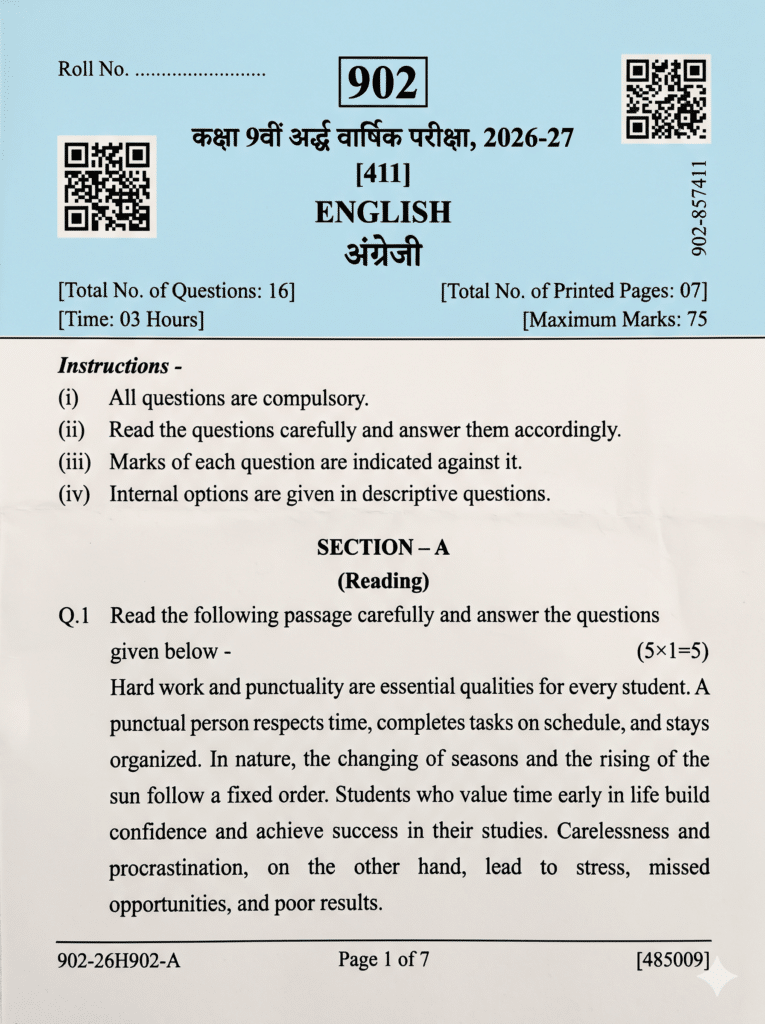
कक्षा 9वीं अर्द्ध वार्षिक परीक्षा, 2026-27
ENGLISH
Instructions –
- All questions are compulsory.
- Read the questions carefully and answer them accordingly.
- Marks of each question are indicated against it.
- Internal options are given in descriptive questions.
Hard work and punctuality are essential qualities for every student. A punctual person respects time, completes tasks on schedule, and stays organized. In nature, the changing of seasons and the rising of the sun follow a fixed order. Students who value time early in life build confidence and achieve success in their studies. Carelessness and procrastination, on the other hand, lead to stress, missed opportunities, and poor results.
- What qualities are described as essential for every student?
- What does a punctual person do?
- What do carelessness and procrastination lead to?
- Which example from nature shows regularity?
- Find a word in the passage that is the opposite of ‘failure’.
Water is vital for all forms of life on Earth. We need water for drinking, cooking, farming, and sanitation. Although water covers a large part of our planet, only a small portion is fresh and safe to use. Pollution and wastage are rapidly reducing clean water supplies. Every citizen must save water by turning off taps when not in use, fixing leaks, and practicing rainwater harvesting.
- Why is water vital for life on Earth?
- What is rapidly reducing clean water supplies?
- Which method of saving water is mentioned in the passage?
- Which word in the passage means ‘essential for life’?
- What should every citizen do to conserve water?
Regular exercise keeps the body fit and the mind active. Walking, jogging, cycling, and yoga improve blood circulation and build stamina. Exercise also helps reduce anxiety and improves sleep quality. People who stay active daily are less prone to lifestyle diseases. Along with physical activity, a balanced diet and enough rest are necessary for good health.
- Importance of Discipline
- Science in Daily Life
- Environmental Conservation
- My Favourite Festival
- She bought ……………… umbrella yesterday. (a / an / the)
- The books are ……………… the bag. (in / on / into)
- How ……………… milk do you drink daily? (many / much / few)
- Speak the truth ……………… you will be punished. (and / or / so)
- He ……………… his homework every evening. (do / does / doing)
- ……………… I borrow your pen for a minute? (May / Must / Should)
- Meera sings a song. (Change into Negative)
- They are reading books. (Change into Passive Voice)
- The box is very heavy. I cannot lift it. (Combine using ‘so…that’)
- He finished his work. (Change into Interrogative)
- Unless it rains, we shall play cricket. (Rewrite using ‘If’)
- honesty / policy / best / is / the. (Rearrange the words to make a meaningful sentence)
- Who is the author of The Fun They Had?
- Where was Evelyn Glennie going when she felt the vibrations of music?
- Where was Dr. A.P.J. Abdul Kalam born?
- What instrument did Ustad Bismillah Khan play?
Tommy looked at her with very superior eyes. “Because it’s not our kind of stupid teacher, stupid. This is the old kind that they had hundreds and hundreds of years ago.” He added loftily, pronouncing the word carefully, “Centuries ago.”
- Who is speaking to whom in these lines?
- What is Tommy talking about?
- Which word in the extract means ‘proudly or in a superior manner’?
Two roads diverged in a yellow wood,
And sorry I could not travel both
And be one traveller, long I stood
And looked down one as far as I could
To where it bent in the undergrowth;
- Name the poem from which these lines have been taken.
- Who is the poet of this poem?
- What does ‘yellow wood’ indicate in the poem?
- What were the main features of the mechanical teacher and the schoolroom?
- How did Evelyn Glennie sense music despite being deaf?
- Why did Emperor Aurangzeb ban the playing of the pungi?
- Why did Kezia’s father punish her?
- Why did Albert Einstein dislike the school system in Munich?
- Who were Kalam’s school friends and what did they later become?
- What did the doctor do when he saw his reflection in the mirror?
- What was the poet’s dilemma in The Road Not Taken?
- How does the wind affect weak things according to the poem Wind?
- What sounds does the poet hear while lying in his bed in Rain on the Roof?
- What did the child want at the fair in The Lost Child?
- Why did Grandfather decide to take Toto to Saharanpur?
- Why did the guru want to leave the Kingdom of Fools?
- How did Evelyn Glennie overcome her disability and achieve success in music?
- Write the central idea of the poem Wind.
- Why did the lost child cry for his parents even after being offered things at the fair?